
Bottom line: larch is a dense, stiff softwood that takes a clean, nearly knot-free face — genuinely a step up from commodity lumber to look at and to walk on. But its heartwood is rated only moderately durable, its sapwood is not durable at all, and it moves about twice as much around the growth rings as it does through them, which is what makes boards cup. It earns its place on appearance and stiffness, not on lifespan — and supply from Russia is restricted under Canadian sanctions. Confirm the origin and available quantity before choosing it.
Buying in Ontario: the CDS Clear Larch collection had no listed products in September 2026. For a project with a fixed schedule, start with the current CDS wood range and confirm the order with the store.
Can you still buy larch? Where it comes from now
Our Ipe and cumaru guides deal with CITES, the conservation treaty that controls trade in those species. Larch is not a CITES species — European larch, Western larch and tamarack are all recorded as not listed in the CITES Appendices. Its constraint is a different one, and for a Canadian buyer it is harder.
Restrictions on buying wood from Russia
Section 3.16 of the Special Economic Measures (Russia) Regulations restricts importing, purchasing or acquiring the listed goods, wherever situated, from Russia or a person in Russia. Schedule 13 includes sawn wood and continuously shaped wood such as grooved boards. The source and transaction matter, not simply the species name.
The amending regulation was registered on 13 June 2025 and this section came into force on the sixtieth day after registration — 12 August 2025. The exceptions are narrow: goods exported from Russia at least sixty days before that date, personal effects, and goods under a contract signed at least sixty days before it and received within a hundred and twenty days after.
That followed an earlier and blunter change. Canada withdrew Most-Favoured-Nation tariff treatment from goods originating in Russia and Belarus effective 2 March 2022, applying the General Tariff rate of 35 per cent. Between the tariff and the prohibition, the commercial route that used to bring Siberian larch to the GTA is closed.
Certification closed too
FSC restricts new certified and controlled-wood sourcing from Russia and Belarus. This is separate from Canadian sanctions. Do not infer that every board called Siberian larch has the same origin or certification status; ask the supplier for the actual records.
What this means for a homeowner, and how to check supply, is answered under common questions.
If you cannot get larch
Larch buyers are usually after one specific thing: a pale, low-knot, real-wood face that is stiffer and harder than commodity softwood, without tropical-hardwood pricing. Several routes get you there.
| Instead of larch | What you gain | What you give up |
|---|---|---|
| Thermally modified wood | An alternative listed by Composite Deck Shop, including Lunawood and thermal red oak. The heat treatment targets exactly the moisture movement that troubles larch — our thermally modified decking guide covers what it buys and what it costs. | A darker, more uniform tone than pale larch, and a different price bracket. |
| Western red cedar | Naturally decay-resistant heartwood and a lightweight board. Durability varies with grade, heartwood content and exposure. | Much softer at 350 lbf, so it marks and dents more easily. |
| Tamarack (eastern larch) | The same genus, native to Ontario, so Canadian-grown supply avoids the Russian sourcing question. | Same moderate durability class, and confirm a supplier of finished decking before choosing it. |
| Pressure-treated softwood | The lowest cost route, and treatment rather than species does the work — the standard answer for a low-durability softwood. | Knots, a green or brown cast, and more surface checking than a clear grade. |
| Garapa | The closest thing to a pale hardwood: 1,650 lbf, rated durable, and locally stocked. | Hardwood pricing, hardwood installation discipline, and heavier boards. |
| Capped composite | No oiling schedule at all, and a long fade-and-stain warranty behind the colour. | It is not wood, and it never will be. See our composite decking hub. |
If you are still weighing species against each other rather than choosing between larch and nothing, our decking materials hub sets every family side by side with the guide behind each one, and the Ontario deck cost guide puts numbers against the shortlist.

What “Clear Siberian Larch” actually names
Three different claims travel inside that phrase, and each needs a separate answer. Confusing them is how a buyer ends up paying a premium for a grade while assuming they bought durability.

“Clear” is an appearance grade. In the larch trade the top grade is usually called unsorted — meaning the lower-quality boards have already been taken out — while sawfalling is the mill run with everything still in it. “Clear”, “select” and “A grade” are merchant words for the same idea: fewer and smaller knots on the face. The trade sources are explicit that decay resistance does not change between grades, and there is no Canadian standard behind the word at all.
“Larch” is a genus, not a species. Four are worth knowing, because a supplier may offer any of them under the same word. The figures below all come from The Wood Database, so the comparison is like-for-like.
| Species | Where it grows | Dried weight | Janka | Decay resistance |
|---|---|---|---|---|
| European larch (Larix decidua) | Central Europe | 575 kg/m³ | 740 lbf | Moderately durable |
| Western larch (Larix occidentalis) | North-western North America | 575 kg/m³ | 830 lbf | Moderately durable |
| Tamarack, or eastern larch (Larix laricina) | Canada, including Ontario | 595 kg/m³ | 590 lbf | Moderately durable |
| Siberian larch (Larix sibirica) | Siberia, Mongolia, northern China | 620–680 kg/m³ air-dry | No Wood Database entry | See below |
The Siberian larch row comes from a different kind of source, and that matters. There is no Wood Database entry for the species, so the figures above are from a 2020 study in Scientific Reports that measured five Mongolian provenances: air-dry density 0.62 to 0.68 g/cm³, mean modulus of rupture 95.4 MPa, modulus of elasticity 8.35 GPa. The authors found statistically significant differences in stiffness and strength between provenances — which is the real lesson. “Siberian larch” is a trade description covering a range of material, not one consistent product.
Compare the same species and units. Janka hardness is measured in pounds-force (lbf), not pounds per square inch. The published European larch figure is 740 lbf; a merchant’s figure for Siberian larch is a separate claim with a separate source.
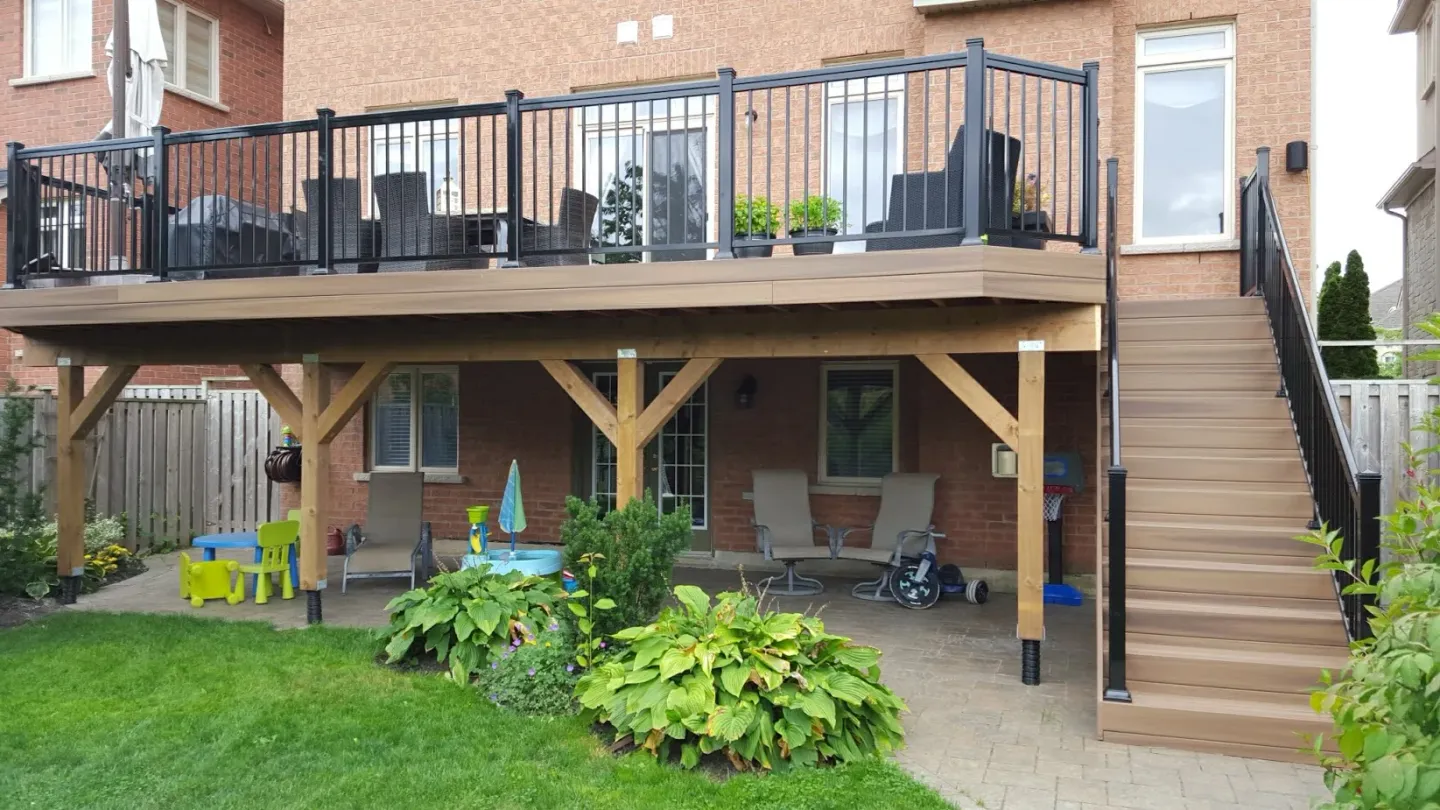
The cover photo shows cedar and pressure-treated wood as an example of a pale, low-knot appearance. It is not a larch project.
Density, hardness and movement
Larch is dense and stiff for a softwood, but it is not the densest. The Wood Database lists European yew at 675 kg/m³ and longleaf pine at 650 kg/m³. Compare the named species rather than treating “larch” as one consistent material.
The property that actually shapes how a larch deck behaves is not density at all. It is movement. Every larch in the reference has a tangential-to-radial shrinkage ratio of about 2.0 — European larch 4.2% radial against 8.2% tangential, Western larch 4.5% against 9.1%, tamarack 3.7% against 7.4%. For comparison, ipe sits at 1.3 and cumaru at 1.5.
A ratio near 2 means the board shrinks and swells about twice as much across the growth rings as through them, and that difference is the mechanism behind cupping. Finish all faces before installation as the product instructions require, and provide drainage and ventilation beneath the deck.
How long a larch deck actually lasts
Decay resistance describes the wood. Deck lifespan also depends on drainage, ventilation, exposure and maintenance, so a species name alone cannot promise a fixed number of years.
Moderately durable heartwood
Plan the deck around drainage and ventilation, not the species alone.
SourceWolman, citing DIN EN 350-2: “only of moderate to low durability (durability class 3 - 4)”. The Wood Database rates European larch, Western larch and tamarack “moderately durable”.
Ratings vary by provenance
Treat any single-number lifespan claim for larch with suspicion.
SourceSiberian larch heartwood is generally described as class 2 to 3; research reports variation by provenance and even individual tree.
Sapwood has no durability
Ask how much sapwood the grade allows — “clear” sorts by knots, not heartwood.
Preservative will not fix it
Do not count on pressure treatment to make up for poor detailing.
SourceWolman rates the heartwood “practically untreatable” (treatability class 4).
Not insect-resistant
Do not assume natural insect resistance.
SourceWolman: the heartwood “is not resistant to wood-destroying insects”.

The cedar comparison is the clearest example. Western red cedar is the softest wood in that chart at 350 lbf — it dents if you drop a barbecue lid on it — and it is also the second most decay-resistant, rated “durable to very durable”. Larch wins on hardness and stiffness and loses on decay class. A higher hardness rating does not establish a longer service life.
For the boundary that actually matters, the Timber Decking and Cladding Association sets it this way: decking should use a species naturally rated “very durable” or “durable”, or “in some cases moderately durable”, or a softwood that has been industrially pressure treated — and “only timber capable of providing a minimum service life of 15 years should be used.” Larch sits exactly on that “in some cases” line. It gets there when the detailing does its share: fall and drainage, ventilated framing, sealed cut ends, and a finish maintained on the product's schedule.
What to ask a seller
If you do find larch decking offered in Ontario, these six questions separate a real answer from a brochure. Ask for the answers in writing on the quote, not in conversation.
Which species?
Larix decidua, occidentalis, sibirica or laricina — not just “larch”.
Which country and mill?
Get where the timber grew and where it was processed.
WhyGiven the import prohibition, this is not a nosy question any more.
Which grade, by name?
Unsorted, sawfalling, A, B — and what the grade rule permits for knots, splits and wane.
Heartwood or mixed?
Ask what proportion of sapwood the grade allows.
WhyThe question that actually predicts decay performance, and almost nobody asks it.
Moisture, measured when?
Get the moisture content and the date it was measured.
WhyKiln-dried and shipped six months ago is not the same board as kiln-dried last week.
Solid edge or grooved?
Settle the profile first — it decides the fastener system.
Installing larch in Ontario
Coat every face before the boards go down
CUTEK’s Canadian documentation recommends coating all faces before installation. The reason is the movement figure above: a board finished only on top dries on one face while the underside keeps drinking moisture from the joists and the ground, and with a T/R ratio near 2 the result is cupping.
Coat every face first
One coat on all faces and ends before installing, a second on top once the first has penetrated.
Maker noteCUTEK Extreme instructions.
Dry, clean wood
Coat only clean, non-greasy wood below 17 per cent moisture.
Maker noteCUTEK
Watch the forecast
Follow the current label for dry weather and drying between thin coats; do not add another coat while the first remains wet.
Maker noteCUTEK
Work to 10 °C
Use the stricter of CUTEK’s two published minimums, and check the tin you bought.
Maker noteThe Canadian product page gives both 10 °C and 5 °C; the technical page gives 5 °C. Below that the oil thickens and goes on too heavy.
Fasteners and splitting
Pre-drill ends and edges
Pre-drill near the ends and edges, where larch splits; elsewhere it is optional with the right screw.
SourceUse the instructions for the selected fastener.
Use stainless
Protect a clean, knot-free face from blue-black iron stain.
SourceUSDA FPL explains the extractive–iron reaction; its most-affected list names oak, redwood, cypress and cedar, not larch.
Match the fastener to the edge
Grooved: hidden clips. Solid edge: an edge-driven system such as CAMO, or colour-matched face screws.
SourceFace screws are cheapest and hold flattest against cupping, but show the most.
Seal the cut ends
Seal every cut; end grain takes water many times faster than a face.
Framing, spacing and tools
Spacing from the drawings
Take joist spacing from the board’s span rating and your approved drawings — see deck construction basics and Toronto deck permits.
SourceCommon spacing for 5/4 softwood is not a universal rule.
Sharp carbide blades
At least 40 teeth on a 7¼ in. blade, 60 on a 10 in., 80 on a 12 in.; no thicker than 1/8 in.
SourceLarch resin gums a dull blade quickly.
Keep water moving
Ventilated framing, a positive fall, and no soil or debris bridging the underside.
SourceFor a moderately durable species, this detailing is the durability strategy.
Care and colour
Leave it bare
Let it silver — a finish, not a failure — and let drainage and ventilation carry the load.
Maker noteGrey on larch sits over moderately durable heartwood, not very durable like ipe or cumaru.
Hold the warm brown
Re-oil on the product’s interval, not once a year by default.
Maker noteCUTEK: roughly six to twelve months on high-exposure horizontal surfaces. DeckWise: one to two years for Ipe Oil.
Restore in order
Clean, brighten, dry fully, then oil. Oil alone will not bring the colour back.
Our deck oils and stains guide covers the products, the Ontario application window and the rag-disposal safety that goes with them.
Common questions
Can I still buy Siberian larch decking in Ontario?
Composite Deck Shop's Clear Larch collection had no listed products when checked in September 2026. Ask the store about documented supply before planning around larch. The wood decking collection offers other species to compare. A botanical name alone does not establish the country of harvest or the legality of a shipment.
Does the import ban affect larch I already own, or boards I buy from a Canadian retailer?
The cited provision regulates specified transactions; it is not a blanket ban on owning an existing larch deck. It also is not limited to professional importers: its wording covers persons in Canada and Canadians abroad. For a proposed purchase, ask for origin and supply-chain records and get advice about the particular transaction if its status is unclear.
Useful sources
Sanctions lists, certification decisions, manufacturer instructions and retail availability all change — several of them faster than anything else on this site. Re-open the linked sources before you rely on a figure here.
- The Wood Database — European larch, Western larch and tamarack: density, Janka hardness, shrinkage and T/R ratio, decay resistance, and CITES and IUCN status.
- The Wood Database — western red cedar, garapa and ipe: the comparison figures used in the chart above.
- Ishiguri et al., “Physical and mechanical properties of wood and their geographic variations in Larix sibirica”, Scientific Reports 10:12812 (2020): air-dry density, strength and stiffness across five provenances, and the variation between them.
- Wolman — larch wood profile: DIN EN 350-2 durability class 3–4 for the heartwood, treatability class 4, insect resistance and resin content.
- Timber Decking and Cladding Association — decking timber options: which natural durability classes are acceptable for decking, and the 15-year minimum service life.
- Special Economic Measures (Russia) Regulations: section 3.16 and Schedule 13, including the listed sawn-wood and shaped-wood categories.
- SOR/2025-143, Canada Gazette Part II: the registration date of 13 June 2025 and the sixty-day coming-into-force provision.
- CBSA Customs Notice 22-02: withdrawal of Most-Favoured-Nation tariff treatment and the 35 per cent General Tariff, effective 2 March 2022.
- Forest Stewardship Council — no FSC material from Russia and Belarus: suspended and terminated certificates, and blocked controlled-wood sourcing.
- CUTEK Canada — technical information: coating all faces before installation, the 17 per cent moisture limit, a 5 °C minimum, the 48-hour rain rule and the thin-coat method.
- CUTEK Canada — Extreme product page: the FAQ section that carries both the 10 °C and the 5 °C minimum, plus the 17 per cent moisture limit and the reason cold weather is a problem.
- Knaebe, M. (2013), Iron Stain on Wood, USDA Forest Products Laboratory: how extractives and iron produce blue-black staining, and which species are most affected.
- Ecochoice — unsorted versus sawfalling larch grades: what the appearance grades permit, and that durability does not change between them.
- Composite Deck Shop — Clear Larch collection and wood decking collection: the catalogue range and prices; confirm availability directly.