

Thermowood’s decay resistance does not eliminate surface care. Decide whether to maintain its brown colour or allow natural silvering, then follow the board and finish instructions for cleaning and upkeep.
When it fits an Ontario yard, and when it does not
Set against the other materials on this site, thermally modified wood occupies a narrow and real position: it is the choice for someone who wants a wood deck, does not want preservative chemicals in it, and accepts regular surface care and the drainage requirements of an above-ground wood deck.
| If this is what matters most | The honest answer |
|---|---|
| Real wood, no preservative chemistry | Thermally modified wood fits; naturally durable untreated species are another option. |
| Boards that stay flat through an Ontario year | Strong case. Halved moisture uptake is what dimensional stability actually means. |
| Hardness underfoot, castors, dogs, a busy entry | Ipe or cumaru. A modified softwood is not in that class and its own maker says so. |
| The lowest possible upkeep | Capped composite or PVC. Thermowood still needs drainage, cleaning and a finish schedule if you want to retain its brown colour. |
| A low deck sitting close to grade with closed sides | Rethink the material or the deck. Under four inches of air over soil, this board is outside its rating. |
| A dock, a pool surround at the water's edge, anything touching soil | Not this. Use classes 4 and 5 carry no ThermoWood recommendation at all. |
The deck surface does not replace the requirements for its structure and guards. Confirm guard height, openings and the approved post connection against the applicable design; a joist minimum from one standard detail is not a rule for every system. See our railings hub and the guard installation guide. Whether you need a permit at all is a municipal question, and Toronto publishes its own thresholds.

What the heat actually does
Thermal modification is a heat treatment carried out in a kiln without adding preservative chemicals. The International ThermoWood Association — the Finnish-founded body that defines the ThermoWood mark and publishes the industry handbook — describes three phases: the kiln is driven up past 100 °C until the timber's moisture content reaches zero, held at the modification temperature under steam, then cooled with a water spray while moisture is deliberately put back, so that “after the cooling phase, the moisture content of ThermoWood® products is 4–7%.”
Steam does two jobs in there. It keeps the wood from igniting at temperatures that would otherwise burn it, and it drives the chemistry that removes the extractives and breaks down the hemicellulose — the sugars that decay fungi eat and that draw water into the cell wall. These changes reduce moisture uptake and improve decay resistance; they do not make wood waterproof or immune to decay. Follow normal wood-dust precautions when cutting and local disposal requirements.
The ThermoWood handbook distinguishes two classes; Thermo-D is the one it specifies for decking:
| Class | Temperature | What it is for |
|---|---|---|
| Thermo-S — S for stability | 190 °C for Nordic pine and spruce | Indoor work, sauna, panelling. Weather resistance is improved, not transformed. |
| Thermo-D — D for durability | 212 °C for Nordic pine and spruce; 212 °C for red oak; 230 °C for radiata pine | The only class the handbook lists for decking. Durability class 2 — “durable” — under EN 350. |
For Lunawood decking, confirm the specified Thermo-D class. Other thermally modified brands use their own specifications: ask for the exact product’s durability evidence and decking installation guide.
Where the rating stops. Durability class 2 maps to use class 3.2 — “outdoor, above ground, exposed to the weather, prolonged wetting conditions.” Use classes 4 and 5, which cover contact with soil and with fresh or salt water, carry no ThermoWood recommendation at all. The handbook's wording is flat: it “is not recommended for structures that come into direct contact with soil or water.” Sleepers laid on the ground, a board that touches soil at a garden edge, a dock — none of that is what this material is rated for.
The trade, in published numbers
Cooking wood at 212 °C takes something out. The handbook publishes both halves of that in the same tables, which is more honesty than most decking literature offers, and the numbers are worth reading before the marketing.

Three consequences follow from the right-hand column:
A surface, never a structure
Build joists, beams, posts and stringers from pressure-treated lumber, a naturally durable species rated for the exposure, or steel. See the framing guide.
SourceThermoWood Handbook: “must not be used for load-bearing structures.”
It splits more easily
Pre-drill, particularly near board ends, and do not drop boards corner-first.
SourceSplitting strength drops 30–40%, impact strength about 25%.
Screws hold less well
For a grooved board, use its approved clip system; use the specified screws and pre-drilling method where face fastening is permitted.
SourceSpruce screw holding goes from 22.0 to 14.9 N/mm², about a third less.
What you get for it is the left column, and it is not a small thing. At high modification temperatures the equilibrium moisture content of spruce is halved, and — this is the sentence that explains the whole material — “irrespective of the air's relative humidity, the equilibrium moisture content of thermally modified timber remains significantly below 20%,” the point at which decay fungi become active. Soak modified and unmodified spruce for 72 hours with their ends sealed and the untreated piece reaches 22% moisture content while the modified one stops at 10–12%. Those tests explain improved decay resistance under suitable exposure; they do not justify ground contact or trapped moisture.
Three boards, three species, one label
“Thermowood” is a process, not a species, and the Ontario shelf makes that obvious. The thermally modified boards in Composite Deck Shop's wood decking collection are not the same board in different colours; the September 2026 catalogue lists the three products below. Confirm the selected dimensions, availability and delivery date with the store.
| Board | Species and origin | Published hardness | Fastening |
|---|---|---|---|
| Lunawood Luna SHP Profix 2 | Nordic spruce, Finland. LunaThermo-D, 26 × 140 mm; see current CDS length options below. | Softwood — the manufacturer says it wears faster than a hard species | Lunawood's own Profix 2 hidden clip |
| 3Peaks Thermal Red Oak | Red oak, described as made in Canada from domestic Canadian wood. 5/4x6, 8–20 ft | 1,200–1,360 lbf Janka, 600–700 kg/m³ | Grooved edge for clips, or square edge for face screws |
| Timbra EX | Couratari spp., South America. 5/4x6 plus 1x6, 2x4 and 2x6 profiles | 1,562 lbf Janka, 741 kg/m³ | Not specified by the supplier — confirm before ordering |
Compare hardness, profile, installation requirements and supply lead time separately. A shared “thermally modified” description does not establish the same decay rating, strength or fastening method. The Lunawood details below apply to Lunawood’s specified decking, not automatically to the red oak or Timbra boards.
Current thermally modified board prices
Compare Lunawood softwood with 3Peaks Thermal Red Oak using current Composite Deck Shop prices. Check the board lengths below and select an edge profile for the red oak.
Composite Deck Shop prices as of Sep 29, 2026 · CAD, before tax and delivery
Board prices only. Include the specified clips or screws, end sealer, finish and delivery in your material quote. Confirm exact dimensions, pickup stock and delivery timing with the store.
The clearances it is built around
Every specification on a thermally modified board assumes the deck lets it dry. Lunawood's North American installation guideline opens on it: “a long-lasting deck requires at least 4 inch of continuous ventilation space under the supporting beam frame.” A deck that ignores those clearances is not using a durable material badly — it is putting the material outside the exposure it is rated for.

Air under the frame
Keep at least 4 in. of continuous open air under the frame over soil, 2 in. over a slab.
Lunawood guidelineA low platform a few inches off a lawn cannot meet this.
Half-open skirting
Leave at least half of each side open — slatted or perforated skirting, not sheet material.
Doubled joists at butt joints
Put a doubled row of joists under every butt joint, with at least 2 in. between them for run-off.
Lunawood guidelineA single joist traps water where end grain is exposed.
Gaps and sealed ends
¼ in. at every board side and end, ¾ in. clear of the wall; seal cut ends on site as they are cut.
Spacing band and fall
Band the top of each joist so boards never sit wood-to-wood, and give the surface a 1–2% fall.
Ordinary framing
16 in. joist spacing for the 5/4 board, with no more than 1½ in. of overhang.
Lunawood guidelineLunawood’s own product table.
Fasteners, pre-drilling and the clip that is brand-locked
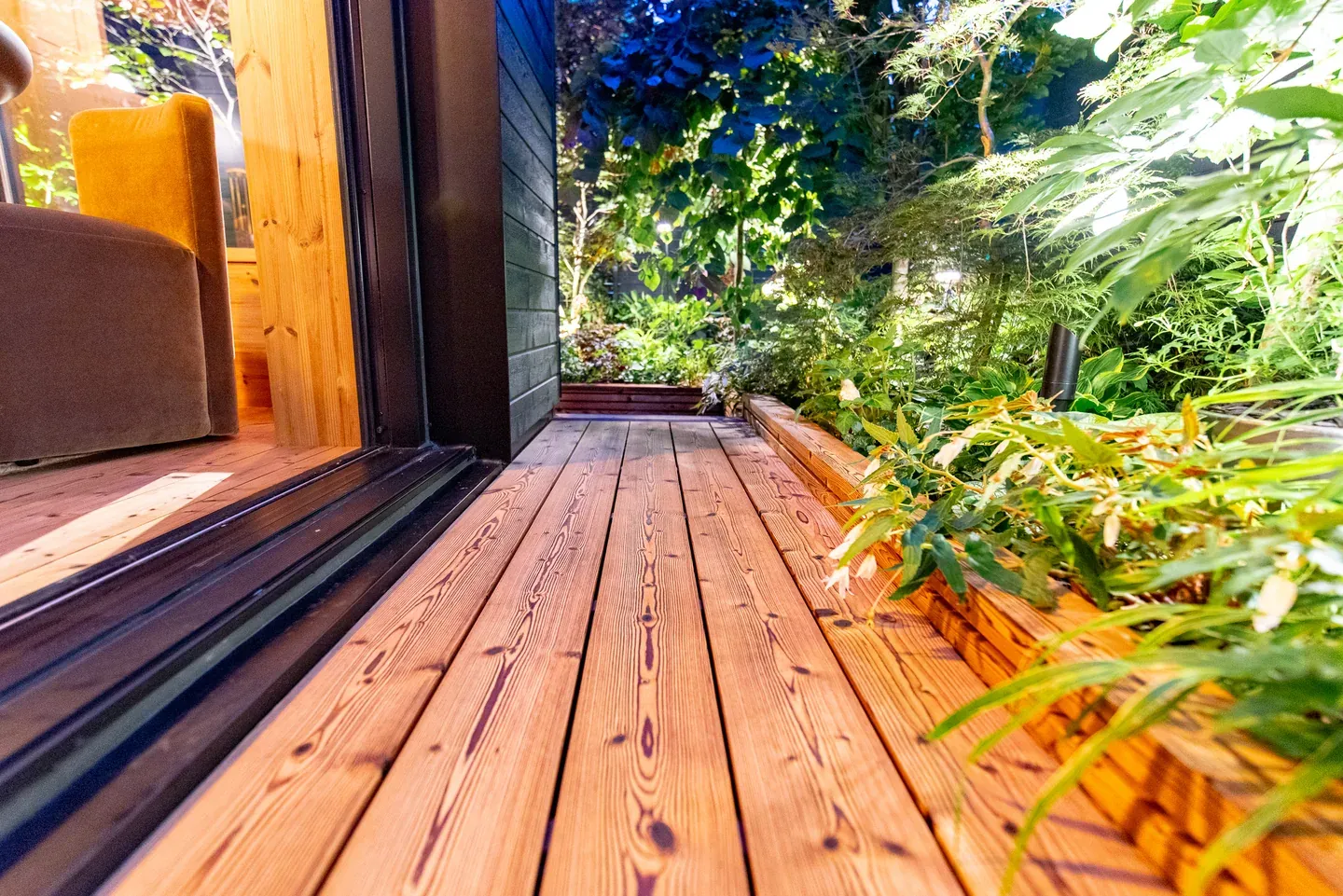
Thermally modified wood is acidic and more brittle than the wood it came from, so fastening is a set of material rules rather than preferences.
Stainless only
A2 (AISI 304) at minimum; step up to A4 / 316 by a pool. Never galvanised.
SourceHandbook: other fasteners react with ThermoWood and stain around the fixing.
Pre-drill the ends, always
Pre-drill at 0.5–0.8 times the screw diameter.
Edge distances
Keep screws 2 in. back from a board end and ¾ in. in from a side edge.
Heads flush
At most 1/16 in. below the surface — 1/32 in. on an oiled board. A pocket is a water trap.
Brand-locked clip
Budget Profix clips and matching stainless screws with the boards: 0.7 clips per foot.
SourceHandbook: “compatible only with other Lunawood products.” It also sets the ¼ in. gap for you.
Let it condition
Allow for boards arriving at 4–7% moisture to settle to site conditions before install.
SourceHandbook: it “may take weeks or even months, particularly in winter.”
Brown, then silver — and what that does not mean
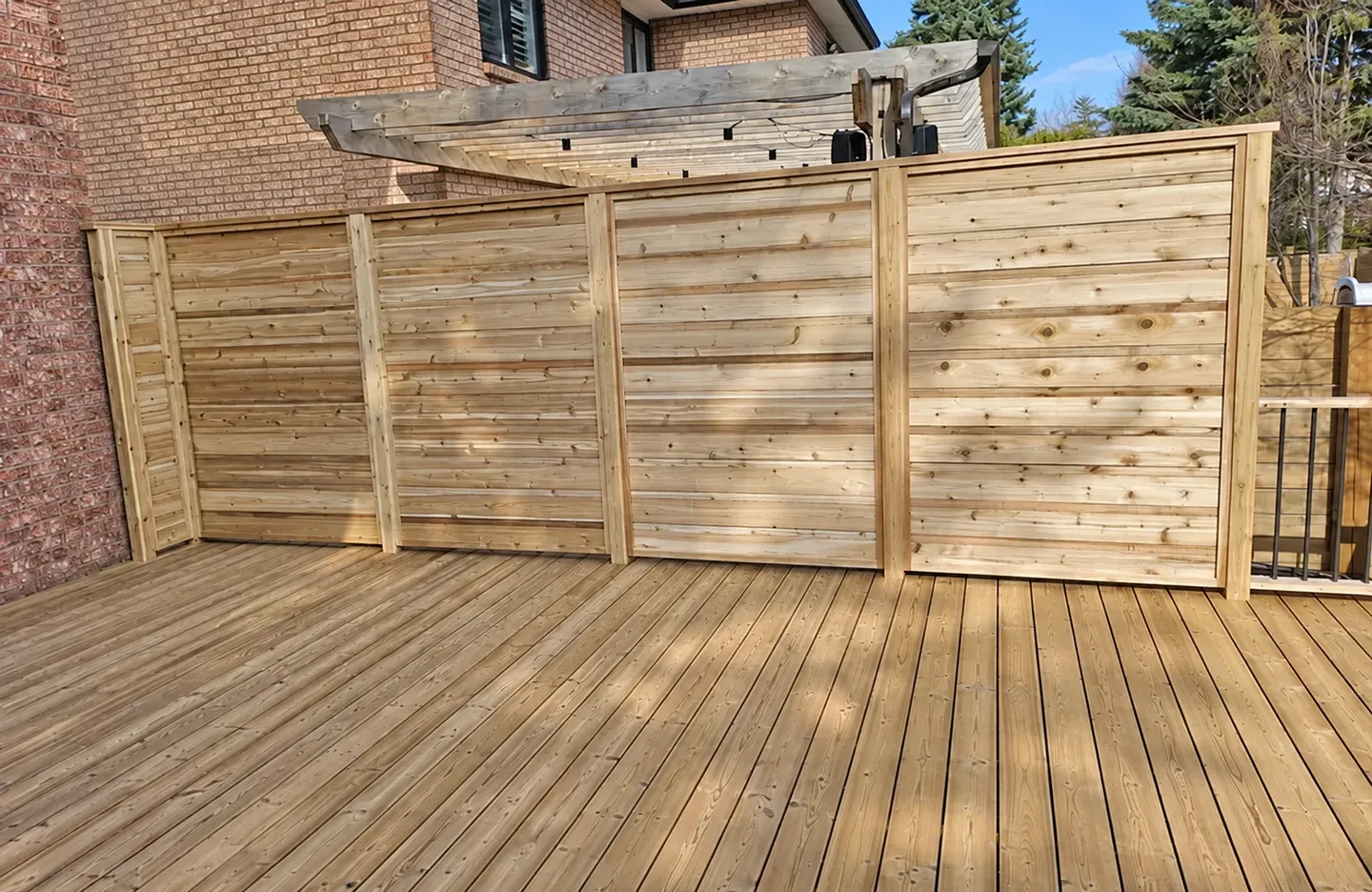
The board in the hero image is the colour Thermo-D comes out of the kiln: brown right through, not stained on the surface. Left alone outdoors it does not stay that way — and grey thermowood is not failing thermowood. So the finish decision is about appearance and surface condition, in three honest options:
Let it silver
No product, no schedule. Wash it and keep leaves and organic debris off.
Maker noteLunawood: grey “does not affect the wood's resistance to decay.” Visible in 3 to 6 months.
Keep the brown
Apply a pigmented oil for thermally modified wood immediately after installation, then about every two years.
Maker noteA clear UV oil “does not prevent natural greying, but slows down the weathering process.”
Oil for the surface
Oil regularly even if grey is the goal.
Maker noteLunawood: oiling “helps reduce cracking and extends the product's lifespan.”
Not linseed oil. It is the traditional answer for bare wood and it is the wrong one here: the ThermoWood Handbook states that “linseed oil is not suitable for ThermoWood® because it enables fungal growth.” Use a deck oil the manufacturer names for thermally modified wood. Our deck oils and stains guide covers product choice, timing and how Ontario expects you to dispose of the rags and the empties.
Two more things that are normal rather than warranty claims: fine hairline checks on the surface, which the care guide says do not affect durability, and small black spots, which come from airborne soot, pollen or metallic dust and from chromogenic fungi in humid air. Both are washable. Pigmented oil at installation is the documented prevention for the spots. Pressure washing is not — Lunawood advises against it because it lifts splinters from an already brittle surface.
Common questions
Is thermally modified wood the same as pressure-treated?
No. Pressure treatment introduces a preservative; thermal modification uses heat to change the wood’s properties. Thermally modified decking still needs drainage, ventilation and the appropriate above-ground exposure.
How long does a thermally modified deck last in Ontario?
Nobody publishes an Ontario number. What exists is the classification and one manufacturer endorsement: the Thermo-D class is durability class 2, "durable," under EN 350, and Lunawood's fact sheet cites a British Research Establishment endorsement of a 30-year expected service life used as cladding and decking. Both of those assume the material is used the way it is rated — above ground, ventilated, never in contact with soil or standing water. A thermally modified board laid tight to the ground on a closed-in frame is outside its own rating, and the number stops meaning anything.
Is it slippery?
Do not assume that grooves make a board safer. Slip performance depends on the tested profile, surface condition and footwear. Water, ice, algae and dirt change traction; keep boards clean and drained, and ask for slip-test information for the exact profile.
How does it compare with Ipe on hardness?
It does not, and the honest version of the comparison starts there. Lunawood's guideline says it outright: its boards are spruce or pine, "which are softwood species. This means that the surface of the decking will wear out faster than decking made with a harder wood species." Ipe is published at 3,490 lbf on the Janka scale and cumaru at 3,330; the thermally modified red oak sold in Ontario is published at 1,200–1,360 lbf. If a dog, patio furniture on castors or a busy side entrance is going to live on this deck, that gap is the thing to weigh — not the decay rating, which thermowood already has.
Useful sources
Manufacturer instructions, product ranges and what is actually in stock all change on their own schedules. Open the sources below and confirm against the exact board before anything is ordered.
- International ThermoWood Association — ThermoWood® Handbook 2025 (PDF): the three-phase process and the 4–7% final moisture content, the Thermo-S and Thermo-D classes with their temperatures by species, the durability and use-class table, the bending, screw-holding, splitting and impact figures quoted above, the load-bearing prohibition, the stainless-steel fastener requirement, and the note on linseed oil.
- Lunawood — Installation Guideline for Lunawood Decking, North America (PDF): the 4 in. and 2 in. ventilation minimums, the ¼ in. and ¾ in. gaps, the doubled joist at board ends, the 50% open skirting rule, the pre-drilling and edge distances, the Profix clip specifications, the joist spacing table, and the slip-resistance finding.
- Lunawood — Thermowood Decking Maintenance and Care Guide (PDF): greying and what it does not mean, pigmented against clear oil, the roughly two-year re-coat, black spots, hairline cracks, and the advice against pressure washing.
- Lunawood — Thermowood Fact Sheet (PDF): the LunaThermo-S and LunaThermo-D definitions, durability class 2 under EN 350, the BRE 30-year service-life endorsement, the 3-to-6-month silvering timeline, and the statement that the material is not termite resistant.
- Composite Deck Shop — wood decking: the Lunawood, 3Peaks Thermal Red Oak and Timbra EX listings and their published specifications. The live collection is the authority on availability and price.
This guide is practical public information, not a specification, an engineering opinion or a substitute for the manufacturer's current instructions. Your municipality, the Building Code edition in force and the documents supplied with the exact board you buy govern your deck.