

Choose by board material. Clean capped composite and PVC with the manufacturer’s approved products; an added coating can affect warranty coverage. For wood, choose a finish approved for the species and walking surface. Composite Deck Shop’s maintenance collection includes CUTEK Extreme and Ipe Oil; confirm package size and availability before ordering.
Start here: does your deck need a finish at all?
The board material decides the answer, and it decides it completely. Applying the right product to the wrong deck is the most expensive mistake in this category, because removing a failed coating costs far more than the coating did.

| Your boards | Finish decision | What routine care looks like |
|---|---|---|
| Capped composite or PVC | Never oil, stain, paint or seal the surface. | Wash with water and a mild, pH-neutral detergent, or the brand's own deck cleaner, at least twice a year. |
| Pressure-treated softwood | Optional. A penetrating stain slows checking and evens the colour; bare treated wood still resists decay. | Clean annually. Re-coat when the existing finish has worn and water begins soaking in, following the finish label. |
| Cedar and thermally modified wood | Semi-transparent penetrating stain if you want to keep the tone, or let it silver evenly. | Clean, then re-coat on the maker's interval. Avoid ordinary paint or varnish on walking boards. Follow the board maker’s coating restrictions, especially for thermally modified wood. |
| Ipe, cumaru and other tropical hardwoods | A pigmented penetrating hardwood oil to hold the brown, or let it weather to silver. | Clean and brighten at least yearly; re-oil on the product's interval, which shortens with sun exposure. |
Whether wood greys is a look, not a failure. Silvering is a very thin surface layer; it does not mean the boards are rotting, and it is why “restore the colour” and “protect the deck” are two different jobs that people often merge into one purchase.
Composite and PVC: clean it, never coat it
This is the clearest rule in deck maintenance, and all three of the brands sold locally publish it in their own words.
Trex
Clean with soap and water. Do not paint or stain — sealing is not required.
Brand positionPainting or staining is not recommended and may void the limited residential fade-and-stain warranty; colour and protection are engineered into the shell.
TimberTech
Warm water and a non-abrasive, pH-neutral detergent, or diluted TimberTech DeckCleaner. No solvents, polishes or abrasives.
Brand positionNever paint or seal Advanced PVC or composite; paint, stain or another coating voids the warranty.
Fiberon
Skip sealants, chlorine bleach and solvent-based cleaners.
Brand position“DON'T attempt to paint, stain or seal your Fiberon composite decking.”
If you want a different colour, the honest answer is new boards or a different brand, not a coating. Coating a capped board trades a 25-year warranty for a surface that will peel and then need stripping. Compare board families in our TimberTech and Fiberon guides, or the composite decking hub.

Penetrating oil versus film-forming coating
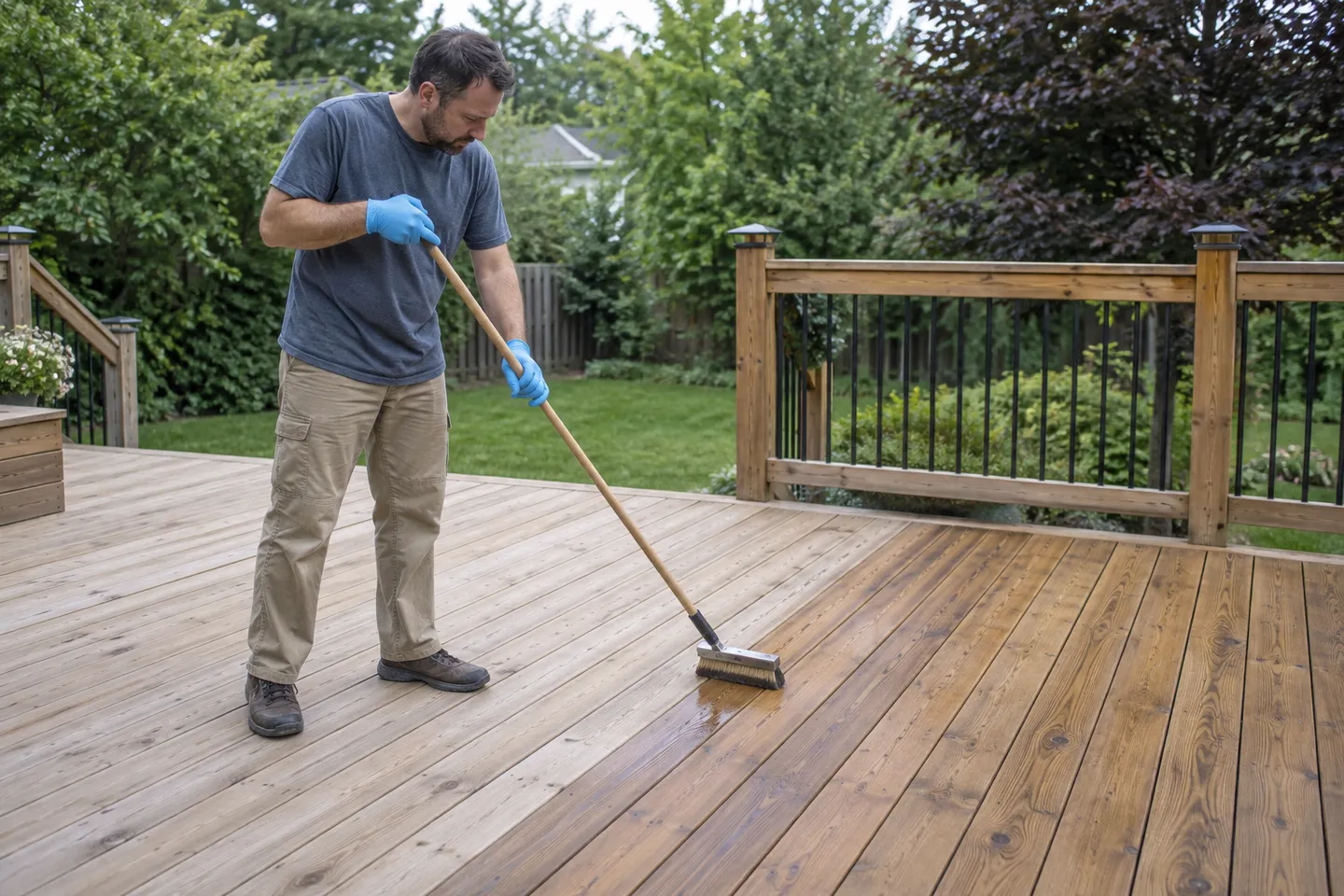
Penetrating finishes are a practical choice for wood decking because they are easier to renew without stripping a surface film. Some coating systems are specifically rated for deck floors; ordinary exterior paint or varnish should not be assumed suitable.
| What to compare | Penetrating oil or stain | Film-forming paint or varnish |
|---|---|---|
| Where it sits | Soaks into the wood; leaves little or no surface layer. | Forms a continuous skin over the wood. |
| How it fails | Fades and thins gradually. You clean and re-coat. | Cracks, blisters and peels once water gets under it. You strip or sand first. |
| On a deck surface | The recommended option — including by the Western Red Cedar Lumber Association for cedar decks. | Not advised for horizontal deck boards; foot traffic, standing water and freeze–thaw cycles all work against the film. |
| Maintenance cost over time | Lower effort per cycle, more frequent cycles. | Longer between cycles in theory, far more work when it does fail. |
What each kind of product actually does
The maintenance aisle looks like a dozen interchangeable tins. It is really five distinct jobs, and buying the wrong one is why people conclude that “deck oil does not work.”
| Product type | The job it does | What it will not do |
|---|---|---|
| Cleaner | Lifts dirt, mildew and grime so a finish can reach the wood. | Does not restore colour or protect anything on its own. |
| Brightener or wood reviver | Neutralises the cleaner and lifts the grey weathered layer back toward the original tone. | Not a finish. Boards left bare after brightening simply start greying again. |
| Penetrating oil or stabiliser | Soaks in to slow moisture movement, checking and cupping. Pigmented versions add UV colour protection. | Does not add structural strength or replace an annual inspection of fasteners, framing and drainage. |
| End-grain sealer | Seals cut ends, which drink water far faster than board faces — used at installation and after every cut. | Not a surface finish for the whole deck. |
| Stripper | Removes a failed coating or a previous incompatible finish before starting over. | Used when a previous coating must be removed; confirm compatibility and follow the stripper’s safety instructions. |
The two penetrating oils sold locally
Both are listed by Composite Deck Shop, and their published instructions differ enough to matter. Use the interval on the tin rather than a calendar rule: a shaded deck goes longer than a south-facing one.
| Published instruction | CUTEK Extreme | DeckWise Ipe Oil |
|---|---|---|
| What it is | A penetrating oil and stabiliser rather than a coating; it diffuses into the wood to control moisture movement. | A pigmented hardwood finish for ipe, cumaru, tigerwood and similar species. |
| Wood moisture | Below 17 per cent | Below 15 per cent |
| Temperature | Plan for at least 10 °C and follow the Canadian label; the website also contains a lower 5 °C limit | Surface between 4 °C and 32 °C |
| Before you start | Clean, dry wood; allow each thin coat to diffuse and dry fully | No rain expected for 24 to 48 hours; new wood aged six to eight weeks first |
| Coats | For an assembled deck, two thin coats on accessible surfaces, letting the first dry completely | Usually one, at roughly 250 ft² per gallon on smooth hardwood |
| Re-coat | Six to twelve months on high-exposure horizontal surfaces | Every one to two years, depending on climate |
| Colour | Untinted, the wood still silvers while staying protected; CUTEK Colourtones slow that down | Pigmented to hold the brown |
Not a deck-surface finish: joist or frame coatings — the rubber-like, water-based barriers rolled onto joists, beams, ledgers and stringers — protect framing where water sits, and reach corners that joist tape misses. They belong in the build, before boards go down. See the deck framing guide for where that fits in the sequence.
Compare current deck oil prices
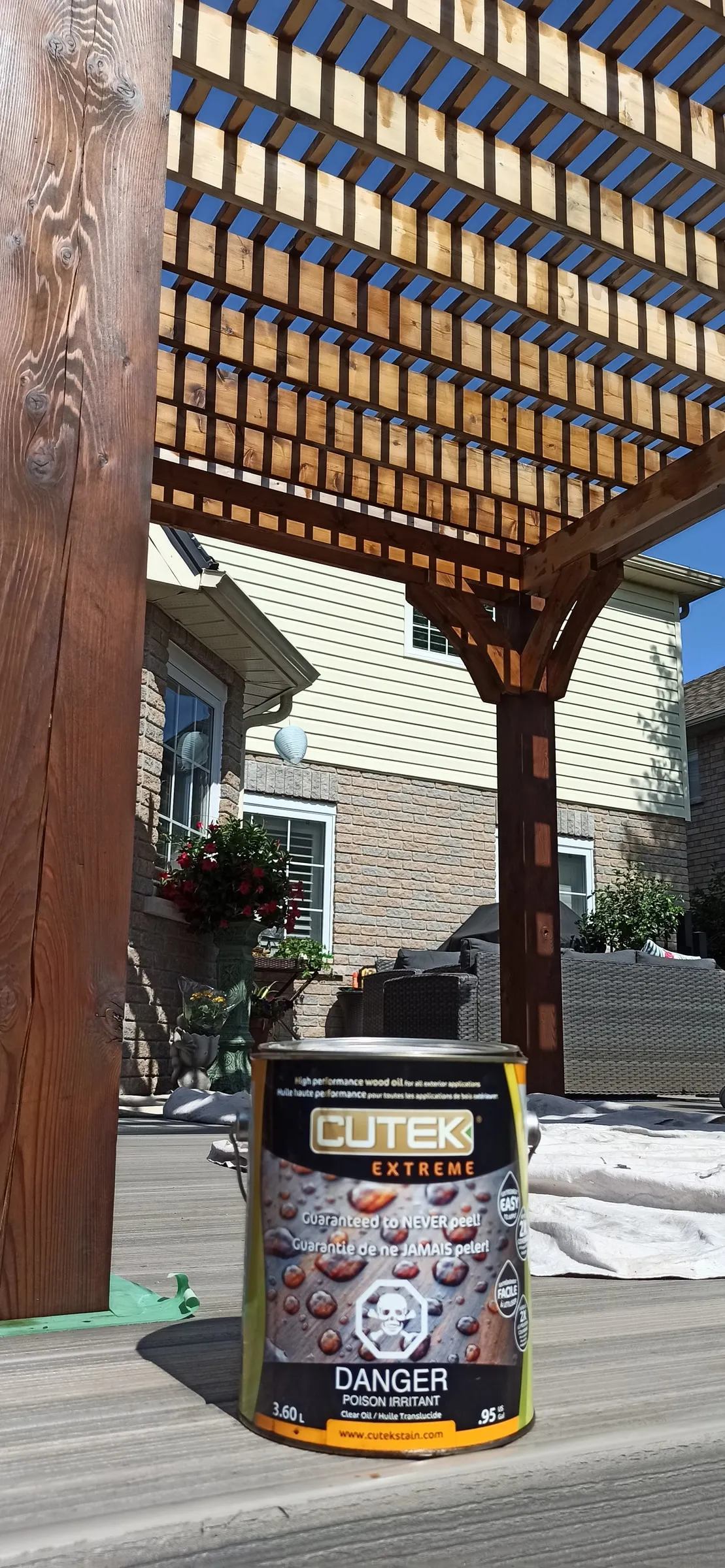
Two CUTEK pail sizes and Ipe Oil, priced by Composite Deck Shop. Compare the package size and the coverage on its label before ordering.
cutek-extreme-deck-oil-0-95-gallon-pail
Composite Deck Shop prices as of Sep 29, 2026 · CAD, before tax and delivery
CAD, before tax and delivery. These are product prices, not installed finishing costs. Confirm the label and finish compatibility for your wood.
The Ontario application window
Ontario gives you a genuinely narrow season for this work, and the limits come from the products themselves rather than from any rule. Put the two sets of manufacturer numbers together and the realistic Greater Toronto window runs from late May through September, with early October possible in a warm, dry autumn.

Check the surface temperature as well as the forecast. Ipe Oil must not go onto a hot surface; CUTEK says heat and ventilation help its oil diffuse. After snow or rain, measure wood moisture even if the top feels dry. Apply the instructions for your chosen oil, not a single rule for all finishes.
Grey, blotchy or previously coated boards
Oil alone does not remove a grey weathered layer or an old coating. Prepare the surface first so the finish can penetrate evenly:
Clear and inspect
Check fasteners, gaps and drainage, and fix loose or damaged boards before finishing over them.
Clean
Use a deck cleaner suited to the wood, following its dwell time. No power-washing.
Brighten or revive
An acid-based brightener or reviver neutralises the cleaner and lifts the grey layer.
WhyThis is the step that actually restores colour.
Dry fully
Let washed wood dry, then measure its moisture against the finish label. Cool or humid weather can require more than 48 hours.
WhyWater beading is a clue, not a moisture measurement.
Test a small area
Finish a hidden board or a step riser first and let it dry.
WhyColour on weathered wood rarely matches the sample card.
Then oil
Only once the surface is clean, bright and dry.
If the deck already carries a peeling film finish, none of this applies until the old coating is off. That is a stripping job first, and worth pricing honestly against replacing the boards — especially on a deck that is already near the end of its life. Our Ontario deck cost guide helps with that comparison.
Application day: the step most people skip
Application methods differ. Ipe Oil has a short wipe-off window; CUTEK is applied in thin coats and needs time to diffuse fully before another coat. Over-application can leave either surface oily or slow to dry.
Along the grain
Two or three boards at a time, the full length of the board, so there are no lap marks mid-deck.
Do not over-apply
Apply the thin, even coat specified by the product; avoid puddles and over-application.
Follow the product’s timing
For Ipe Oil, wipe off oil that has not absorbed within 10–20 minutes. CUTEK uses thin coats that diffuse into the wood; do not borrow another oil’s timing.
SourceRead the label for the formulation you bought.
End grain and details
Work cut ends, nail holes and checks — they absorb far more and let water in first.
Respect the cure
Wait until the wood is dry and non-greasy before a second coat.
SourceCUTEK drying can take several days, depending on wood and weather. Test that the first coat is dry before adding another.
Rags and getting rid of the leftovers
Oil-soaked rags are a real fire risk
This is not a disclaimer added out of caution. CCOHS explains that oils in waste react slowly with oxygen and release heat; if that heat cannot escape, the material can reach its own ignition temperature. Their example is a rag in the bottom of a pail — the same rag on a clothesline gets enough airflow that nothing happens.
- Never ball up used cloths or leave them in a pile, a bag or a bucket.
- Put them in an approved metal oily-waste container with a self-closing lid, and empty it regularly.
- DeckWise's own instruction for Ipe Oil rags is a sealed, water-filled metal container, immediately.
- Set the container out before you open the tin, not after you finish and want to go inside.
Disposal in Toronto and Ontario
Leftover stain, oil and solvent cannot go in the garbage, the blue bin or down a drain. The City of Toronto is explicit that household hazardous waste needs special handling because it can injure workers and cause fires in collection trucks. Keep everything in its original container, sealed, with the label attached, and never mix products together. Toronto's three free options are each capped at 50 litres or kilograms:
Toxic Taxi
Book a free pickup online or through 311 for 10 to 50 litres.
DetailKeep waste sealed in labelled containers, inside an open-topped carrying box, following the booking instructions.
Drop-off depots
Take it to a depot — open year-round, across the city.
Community Environment Days
Bring it to a seasonal neighbourhood event.
Outside Toronto
Use Product Care Recycling: free drop-off for residential paint and stain.
DetailMore than 400 Ontario locations plus hundreds of municipal events a year.
Common questions
How long should new pressure-treated lumber dry before staining?
Use a moisture meter and the finish label rather than a fixed waiting period. A water-drop test only indicates surface absorption: beading can also mean an existing coating or surface contamination. DeckWise specifies below 15% moisture and CUTEK below 17%.
Can I power-wash the deck before oiling it?
Avoid it. The Western Red Cedar Lumber Association warns against power-washing a deck at all, because it raises and damages the wood fibres — a common cause of the fuzzy, blotchy surface that then refuses to take a finish evenly. Use a deck cleaner suited to the wood and follow its dwell time instead.
What does “250 VOC” on the label mean in Canada?
Federal regulations under the Canadian Environmental Protection Act cap volatile organic compound content for architectural coatings sold anywhere in Canada. Exterior wood stains and most other stains are limited to 250 g/L, and waterproofing sealers outside the concrete-and-masonry category to the same 250 g/L; the prohibition covers manufacture, import and sale. A hardwood oil labelled “250 VOC” sits at the Canadian ceiling, while low-VOC versions such as a 100 VOC formulation exist for stricter jurisdictions elsewhere. A higher-VOC product found on a US site may not be legally sold in Canada, so check the number before ordering across the border.
Useful sources
Manufacturer instructions, warranty terms, regulated VOC limits and municipal collection programs all change. Re-open the linked sources and the label on your own product before starting work.
- Trex — product FAQ: painting/staining not recommended and may void the fade-and-stain warranty; cleaning method.
- TimberTech — care and cleaning and its fade and stain warranty: never paint or seal; coatings void the warranty; pH-neutral cleaning.
- Fiberon — deck maintenance and care: do not paint, stain or seal; sealants not recommended; cleaning cautions.
- CUTEK Canada — Extreme: penetrating oil, moisture and temperature limits, thin-coat method, coverage and maintenance intervals, Colourtones and UV colour protection.
- DeckWise — Ipe Oil hardwood finish: preparation, moisture and temperature limits, coverage, the wipe-off window, re-application intervals, VOC versions and the rag warning.
- Western Red Cedar Lumber Association — deck finishing: penetrating finishes for deck surfaces, application technique, end-grain treatment and the power-washing warning.
- VOC Concentration Limits for Architectural Coatings Regulations (SOR/2009-264): 250 g/L limits for exterior wood stain, other stains and other waterproofing sealers; scope of the prohibition.
- CCOHS — working safely with flammable and combustible liquids: how self-heating leads to spontaneous combustion, and approved metal containers for soaked cloths.
- City of Toronto — household hazardous waste: Toxic Taxi, depots, Community Environment Days, quantity caps and container rules.
- Product Care Recycling — paint recycling in Ontario: free drop-off network and container requirements.
- Composite Deck Shop — maintenance range: the current products, stock and prices.