

Both metals need care. Exposed steel can rust. Aluminum does not form iron rust, but its coating and connections still need cleaning, inspection and the maintenance required by the manufacturer.
A scratch has different consequences on steel and aluminum. Compare the coating system, exposure and warranty requirements as well as the appearance.
Start with the locally listed systems. Composite Deck Shop lists aluminum railing options. Compare their appearance, installation details and finish warranty first; if you prefer a steel design, confirm a supplier and the exact Canadian system before planning around it.
How to actually choose
Strip the marketing out and the decision comes down to four questions, in this order.
What should it look like?
Choose a steel system if its profile suits the design; compare its specific finish and warranty with an aluminum alternative.
NoteThe named steel systems below advertise 15-year terms; other products can differ.
How exposed is it?
Beside a salted driveway, a pool or open water, weigh the coastal and finish terms for your exact system.
Will they touch up the cuts?
Ask your installer out loud before work starts — see why.
NoteThe single highest-leverage question on this page.
What does the frame allow?
Take post spacing, blocking and joist size from the system and the Code. See the installation guide and railings hub.
NoteFortress aluminum panels cap post spacing at 69¾ in. (6 ft panel) and 93¾ in. (8 ft panel).
If the answer to the first question is “I mostly want the view,” the comparison you actually want is a different one — our glass railings guide covers what glass changes, including the engineering the Ontario deck guide requires for a prefabricated guard system and its glass.
“Iron” is a shape, not a material any more
Start here, because it dissolves half the argument. Many factory-made railings described as “iron” are powder-coated steel; custom wrought-iron work is a separate category. Check the actual substrate, and its own manufacturer says so plainly: Fortress describes Fe26 as “a pre-welded, easily customized and enhanced version of traditional wrought iron railing,” built from “pre-galvanized steel, zinc phosphate, e-coat and premium powder coating.” Trex's steel line is Enhance Steel, sold as its entry-level metal railing.
So the comparison is steel against aluminum, and the word “iron” is telling you about a look — a heavier, more ornamental profile with thinner pickets — rather than about what arrives on the truck. That reframing is what makes the rest of the evidence line up, because steel and aluminum behave very differently in exactly one respect that matters outdoors.
Why aluminum does not rust, and what it does instead
Both systems arrive with a coating over the metal. The question that decides how each one ages is what sits underneath when that coating is breached — by a fitter's saw, a snow shovel, a dropped tool, or twenty winters.

Three things follow from that drawing, and they are the honest version of the old comparison table:
Steel: the coating is everything
Treat any breach in a steel railing’s coating as exposed ordinary steel.
SourceFortress layers galvanizing, zinc phosphate, an electrocoat and powder coat — four insurances on the same bet.
Aluminum: partly the metal itself
Expect the powder coat to do colour, UV and barrier duty — not to stand alone against rust.
SourceFPL: aluminum and stainless steels “have extremely stable oxide layers that account for their corrosion resistance.”
Neither means no consequences
Watch for lost finish, pitting and galvanic corrosion at wet, mixed-metal joints — see the post connection.
What the companies that sell both metals actually promise
Marketing claims about corrosion are worth very little on either side. Warranty terms are worth a great deal more, because they are the number a company is willing to be held to — and the most useful ones come from manufacturers who sell both metals and have no reason to talk their own steel down.

Two things in that chart are worth more than the individual numbers.
The advertised warranty periods differ, but they do not predict lifespan. Fortress lists 15 years for Fe26 and a limited lifetime for Al13 PLUS; Trex lists 15 years for Enhance Steel and 25 or 50 years for its named aluminum lines. Compare what each contract covers before drawing conclusions from the headline number.
The metal and the finish are warranted separately. Century — a Canadian manufacturer, on the Ontario shelf — publishes the split most clearly: 20 years that the structure will be free from material and manufacturing defects, but only 5 years that the “Powdercoat Paint finish on the Products will not crack, chip, blister or lose paint adhesion.” The part holding you up is warranted for four times as long as the part you look at. Once you have seen that, the rest of this page is fairly obvious.
A warranty term is not a service life. It is a bounded promise about defects, prorated and hedged, and on both Fortress documents it is narrower than it first sounds: corrosion coverage applies only where there are “multiple rust-through perforation instances on the same piece of product.” Distinguish excluded scratches and surface damage from a manufacturing defect in the finish that may be covered.
The finish is the part that ages — and its riskiest hour is installation day
If the coating is what decides the outcome, the interesting question becomes when the coating is most likely to be damaged. The research and the manufacturer's instructions agree, and the answer is not year fifteen.
The Forest Products Laboratory states the general case: “Coatings fail when the corrosive environment can reach the metal substrate. This can happen if the coating is mechanically damaged during installation.” Fortress builds the remedy straight into its instructions. At every cut point the installer is told to remove all metal shavings, file the sharp edges, wipe off filings and grime, and then “apply two coats of Fortress zinc based touch-up paint to the cut area.” It also asks for the shavings to be swept off the deck surface so they do not stain the boards.
Set that beside the warranty line — “surface corrosion from scratches, nicks, and dents are not covered” — and the conclusion is unavoidable. Every cut a fitter makes is a small deliberate breach in the only thing protecting the metal, and it is outside the warranty from the moment it is made. On a railing, cuts are not rare: they happen at every stair, every corner, every run that does not land on a whole panel.

So the practical instruction, whichever metal you buy, is a single sentence to your installer: touch up every cut before the piece goes on, and show me. It is five minutes of work on the one day it can be done easily.
Six things that quietly void a railing warranty
These are not fine print in the pejorative sense — they are in the first two paragraphs of documents almost nobody opens. All six apply to steel and aluminum alike.
Welding, drilling or cutting
Do no fabrication the installation instructions do not call for.
Warranty textCentury excludes it; Fortress lists welding among uncovered causes. The “iron can be welded back” argument does not survive a manufactured system.
No maintenance record
Keep dated photos of quarterly cleaning — monthly in higher traffic or dirtier air.
Warranty textFortress: “The purchaser must do quarterly maintenance and show a record of that maintenance.” Century is void without its care regime.
Ice-melt chemicals
Keep de-icer off the guard and rinse what lands on it.
Warranty textBoth Fortress warranties exclude “harsh chemicals, pool chemicals or chemicals for ice removal.”
The wrong cleaner
Warm water and a non-abrasive, pH-neutral detergent, rinsed thoroughly.
Warranty textBoth warn against “strong solvents such as thinners, or solutions containing chlorinated hydrocarbons, esters, or ketones,” and abrasives.
An install off the manual
Install to the manufacturer’s instructions and to local building code.
Warranty textCentury voids coverage for either failure. A guard is a life-safety element.
Assuming it moves with the house
Treat a long term as a promise about parts, for you only.
Warranty textNeither Fortress warranty is transferable, and restitution “will not include labor to remove existing components or install the replacement components.”
Salt, and the one line both warranties share
Most railing content written for a North American audience treats salt as a coastal problem. Ontario's version arrives in a bag, in January, and gets tracked onto the deck on boots — and it is named directly in the documents.
Both Fortress warranties exclude damage caused by “harsh chemicals, pool chemicals or chemicals for ice removal, air pollutants.” That is the most locally relevant sentence in either document, so keep those products off the guard. Note what it is and is not: it is not a claim that de-icer destroys railings. It is a statement that if it does, that is not covered.
The coastal clauses are worth reading too, because they are where the two metals separate most sharply. Within a mile of the coastline, Fortress reduces the Fe26 steel term to one year and the Al13 PLUS aluminum term to seven. Century reduces its powdercoat finish term from five years to one in a “salt condition location” — and defines that to include salt water pools, not only open ocean. Almost nobody in the GTA is within a mile of an ocean. Quite a lot of people have a salt pool.
Match the warranty to the exposure. Keep de-icing chemicals off the guard. For a salt pool, ask specifically about finish coverage. A freshwater lake or salted road is not automatically the manufacturer’s defined “coastal” location; have the supplier confirm how its terms apply.
Where an aluminum post meets a treated frame
The post connection matters as much as the railing finish. Check the fasteners, blocking and exposure where the post meets the frame. Our railing installation guide explains what to confirm before anyone drills.

Read that assembly as materials rather than as parts and it is aluminum, galvanized steel and copper-bearing pressure-treated lumber, held together in a joint that gets wet. The Forest Products Laboratory describes exactly that combination failing on treated-wood sign posts: “the aluminum signs exhibited excessive corrosion around the lag screw, causing the sign to fall off in some cases. In this case, aluminum was acting as the anode, the galvanized lag screw, the cathode, and wood the electrolyte.”
Two qualifications keep that from being alarmism, and both are useful:
Water is the switch
Keep the post base draining, drying and aired — not sitting in a puddle under a planter.
SourceFPL: “when the wood is dry, embedded metals do not corrode”; the rate climbs steeply with wood moisture.
The preservative matters
Use exactly the fasteners the system specifies for copper-treated lumber.
SourceIn FPL’s test data aluminum corroded far faster in ACQ than in CCA, and faster still with micronized copper azole.
None of this means a correctly built aluminum guard is a problem — it is the mainstream Ontario system for good reasons. It means the base plate is the thing to look at when you walk the deck each spring, on either metal: the fasteners the manual actually names rather than substitutes, no standing water at the post, no bare cut edges, and a coating that is still whole where the bracket clamps down.
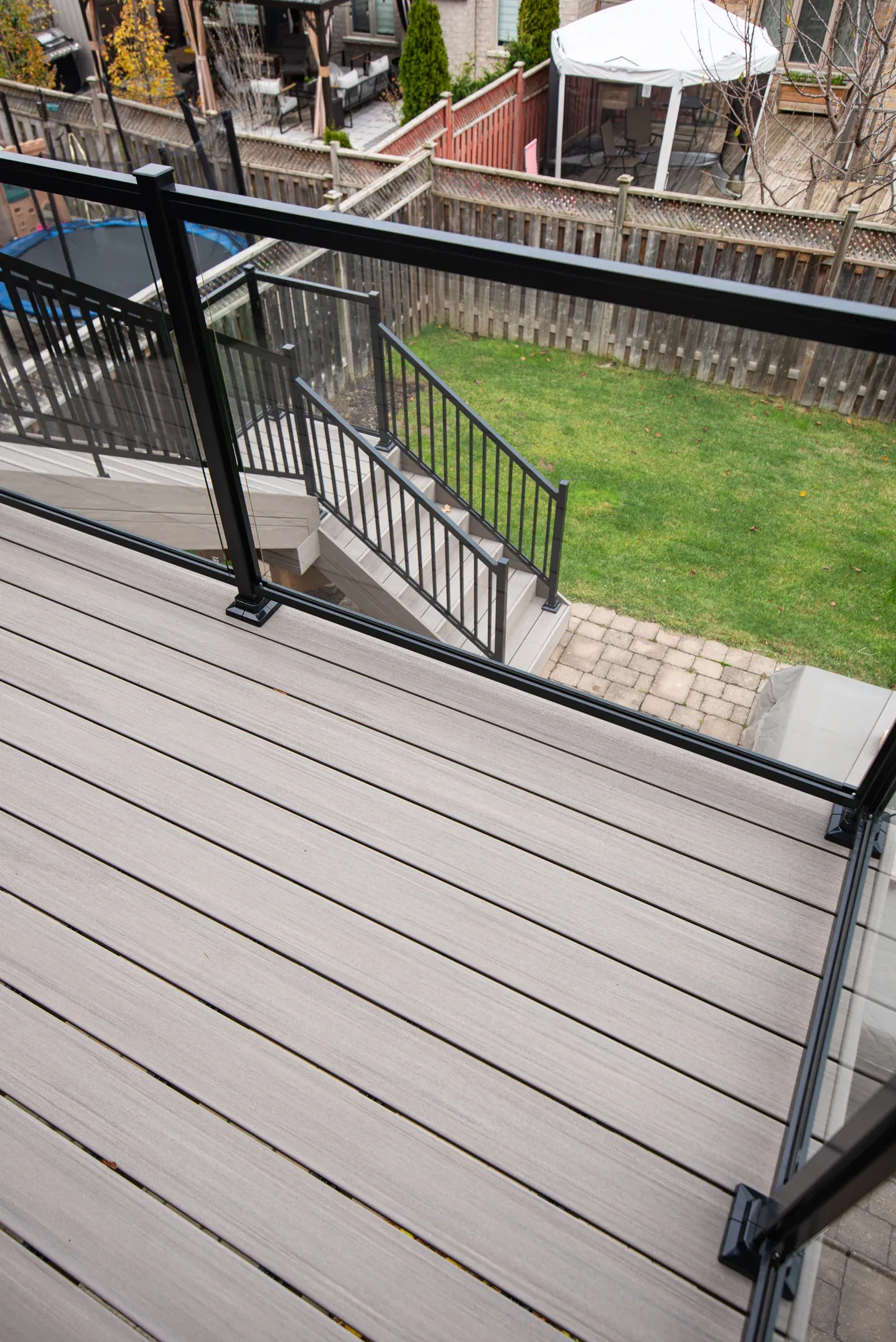
Composite Deck Shop’s aluminum railing collection is a useful Ontario starting point. Its railings and fences collection lists the wider range. No steel railing system was found in the September 2026 CDS catalogue check; ask the store about sourcing rather than assuming it is stocked or available to order.
Useful sources
Warranty terms, product lines and installation instructions are all revised on their own schedules, and a warranty is only ever the one in force for the exact system you buy. Open the documents below and confirm before ordering.
- Fortress — Fe26 Steel Railing Warranty (PDF): the 15-year term, the definition of extensive corrosion as multiple rust-through perforations, the exclusion of surface corrosion from scratches, nicks and dents, the ice-removal chemical exclusion, the one-year term within a mile of the coastline, the cleaning cadence of three to four monthly intervals, and the non-transferable, labour-excluded conditions.
- Fortress — Al13 PLUS aluminum railing, and its Limited Lifetime Warranty document: the limited lifetime term, the identical corrosion and surface-damage definitions, the seven-year coastal term, and the requirement that “the purchaser must do quarterly maintenance and show a record of that maintenance.”
- Fortress — Al13 PLUS installation instructions (PDF): the zinc-based touch-up paint at every cut, the metal-shaving removal, posts secured to the framing and never to the deck boards alone, the treated wood block at 1½ in. minimum, the ½ in. base-plate clearances, four ⅜ in. hex head galvanized bolts per post with lag screws prohibited, and the 69¾ in. and 93¾ in. maximum post spacings.
- Century Aluminum Railings — Limited Warranty and care instructions (CenDek Railings Ltd.): 20 years on the structure against 5 years on the powdercoat finish, the one-year finish term in a salt condition location including salt water pools, and the clauses voiding coverage for welding, drilling or cutting outside the instructions, for failing the care regime, and for installation not conforming to local building codes.
- Trex — railing lines and published warranty terms: Enhance Steel at 15 years against Select aluminum at 25 and Signature aluminum at 50.
- USDA Forest Products Laboratory — FPL-GTR-227, Guide for Materials Selection and Design for Metals Used in Contact with Copper-Treated Wood (PDF, with the Federal Highway Administration): passivation and the stable oxide layers of aluminum and stainless steels, coatings failing where they are mechanically damaged during installation, the moisture dependence of corrosion in wood, the relative corrosivity of ACQ, CCA and micronized formulations to aluminum, and the treated-wood sign-post case of galvanic corrosion.
- Fortress Fe26 product description via ARCAT: the “enhanced version of traditional wrought iron” framing and the pre-galvanized steel, zinc phosphate, e-coat and powder coat stack.
- Composite Deck Shop — aluminum railings and railings and fences: the current Ontario range. The live collections are the authority on availability and price.
This guide is practical public information, not engineering advice or a substitute for approved drawings. A guard is a life-safety element: your municipality, the Building Code edition in force, and the current instructions and warranty for the exact system you buy govern your deck. Guard heights, openings and the connection itself are covered on our railings hub and in the installation guide.