

Choose warm, controlled light. A lower correlated colour temperature means warmer light. DarkSky International recommends 3000 K or lower for residential outdoor lighting. Aim light at the walking surface and choose only the brightness you need.
Lighting near a pool or hot tub needs a separate electrical check. Confirm the applicable Ontario Electrical Safety Code requirements before choosing fixtures or routing cables.
Buying in Ontario: Composite Deck Shop lists in-lite lighting and components. Start with the areas you want to light, then choose a compatible system and have the supplier check its transformer and cable plan. Brand-specific examples below help explain the decisions; their electrical limits do not transfer to another system.
The decision with a deadline
Here is the sentence that ought to open every article on this topic, and almost never does. From Trex's own installation instructions:
“Install wiring and splitters before decking and railing have been installed. DO NOT run wires between joists and deck boards.”
TimberTech puts the same instruction one step earlier: “Do not begin deck construction until you have read the lighting instructions,” because “modifications must be made to railing components during assembly to accommodate wiring and fixtures.” Two competing manufacturers, writing independently, both put the lighting decision before the frame is finished.

The reason is mechanical rather than bureaucratic. Wiring on a deck runs under the framing and behind the stringers, and the connections are made from below. Once the boards are screwed down, that space is behind a fixed surface. TimberTech says as much about its own in-deck fixture: it “can only be used when there is room under the deck to access the wires to make all of the connections.”
The practical test for a retrofit. Can you get under the deck? A raised deck with open access below is a realistic retrofit. A ground-level deck on sleepers, or one with sealed skirting, usually is not — and the honest answer there is riser lights on the stairs, post-mounted fixtures, and garden lighting that never has to cross the deck surface. That is a smaller plan, but it is a plan that can actually be installed.
If you have not settled the boards yet, this is one of the decisions our build-a-deck planner puts in Phase 1 for exactly this reason, and our deck construction guide covers the same principle for every other service: rough-ins cannot be casually drilled through structural members after the fact.
Two electrical systems, one deck
A lit deck almost always carries two separate electrical systems, and most confusion about permits, installers and safety comes from treating them as one thing.
Extra-low-voltage fixtures
The transformer feeds compatible deck and landscape lights. Check cable limits, connector protection and equipment approval for the location.
Planning checkConfirm the installation scope and notification requirements with ESA.
The 120 V supply
The outdoor receptacle and new branch-circuit wiring are a separate part of the plan. ESA specifies Class A GFCI protection and an Extra Duty cover where exposed to rain or snow.
Planning checkPlan this work with a Licensed Electrical Contractor.
The 12 V side is what people mean by deck lighting: riser, recessed, rail and post fixtures, fed from a transformer rather than from the panel. ESA describes that transformer as “a special isolating transformer, which helps prevent shock and short circuits” — the isolation is the whole point, and it reduces electrical risk, but does not make damaged wiring, wet connections or unsuitable equipment safe. Disconnect power before fitting or servicing the system and follow its instructions.
The 120 V side is the receptacle that transformer plugs into, plus anything overhead: soffit downlights in a pergola or cabana, sconces by the door, an outdoor kitchen. ESA's rule for all of it is short and worth memorising: “All 120-volt 15- and 20-amp receptacles in your backyard must be protected by a Class A Ground Fault Circuit Interrupter (GFCI),” and a receptacle exposed to rain or snow “needs to have a cover plate marked ‘Extra Duty.’”
A word that means two different things. ESA also uses “low voltage” in the Code sense of anything under 750 volts, which includes an ordinary 120 V circuit. When it publishes trench depths for “low voltage lighting at less than 750 volts” — 60–90 cm where the trench crosses a driveway and 45–60 cm where it stays in the yard — that is the 120 V feed to the garden, not the 12 V cable between your fixtures. Before anyone digs, ESA also directs homeowners to contact Ontario One Call to locate existing services.
What Ontario asks you to file
Settle the electrical notification and inspection requirements before the frame is closed in.
Confirm the electrical scope before work starts. ESA requires notification for most electrical work. New receptacles, branch circuits and fixed wiring should be planned with a Licensed Electrical Contractor. A homeowner doing permitted DIY electrical work must still follow ESA’s notification and inspection process.
For a plug-in landscape-lighting system, describe the transformer, wiring and installation to ESA and confirm the notification requirements. Do not assume that 12 V or a plug-in connection makes the job exempt.
Put responsibility in the quote. Record who files with ESA and arranges any required inspection. Call 1-877-ESA-SAFE if the scope is unclear. A building permit and an electrical notification are separate; our Toronto permit guide covers the building side.
Where the light actually goes
Six positions cover almost every residential deck. Each has a different job, a different install moment and — as the next section shows — a very different appetite for power.
Riser lights
Put them in the step faces — light on the tread without glare in your eyes.
Manufacturer noteTrex: “generally 4″ (102 mm) above tread”; “consult local codes for lighting requirements.”
Recessed in-deck lights
Use them to mark an edge or level change, in low foot traffic, only where you can reach underneath.
Manufacturer noteTrex: a 1″ hole 3/4″ deep that “cannot go all the way through deckboard or light will fall through.”
Post cap lights
Fit after the post sleeve and skirt — and budget transformer capacity for them.
Manufacturer noteThe fixture that eats capacity fastest on Trex's own numbers.
Rail and accent lights
Mount on a post face or under a top rail — never cut into a rail or baluster.
Manufacturer noteBoth manufacturers draw that line: those are structural parts of a guard.
Path and spread lights
Light the route to the deck with compatible fixtures, within the system’s cable and load limits.
Manufacturer noteThis is where a deck plan becomes a landscape plan — see the permit question.
Overhead downlights
Bring an electrician in early for pergola, cabana or soffit lights.
Manufacturer noteAlmost always 120 V branch-circuit work, not the low-voltage system.

Two prohibitions apply across both systems and are worth repeating because they are easy to break with a hole saw. Trex: “DO NOT install riser light or deck rail light into top or bottom rails or balusters.” And on the deck surface: the recessed fixture's hole “cannot go all the way through deckboard or light will fall through.” A guard's rails and balusters are structural — our railing installation guide covers what they are doing and why nothing gets cut into them.
Transformers, runs and voltage drop
This is where a lighting plan stops being a mood board. Both manufacturers publish a hard ceiling, in different units, and the interesting thing is what each one reveals about the other.

Post caps are the expensive fixture. That is the planning insight buried in Trex's table, and it is simple arithmetic on their own numbers: 285 riser lights against 85 post caps on the same transformer means one post cap costs about three and a half riser lights of capacity. If your sketch has a post cap on every guard post, you are designing a bigger power supply than you think — and the deck's guard post spacing, not your taste in fixtures, is what set that number.
TimberTech's units make an ordinary plan easy to check. Six 3″ post caps at 4 W is 24 W; eight in-deck lights at 1 W is 8 W; the whole plan is 32 W, comfortably inside both the 60 W single-run cap and the 90 W transformer cap. Do that arithmetic before you buy, not after — TimberTech also specifies that “when connecting multiple lights, circuit must be done in parallel (not in a series),” so a run's load is the sum of everything on it.
Voltage drop, which is what actually goes wrong
A 12 V system that is inside its wattage budget can still disappoint, because voltage falls along the cable and the last fixture on a long run goes dim and shifts colour. Kichler publishes the arithmetic for it, and it is the one piece of general method on this page that is not tied to a single deck brand:
Total the load first
Keep the total VA at or below the transformer's wattage.
SourceKichler
Check the far end
Voltage drop = (2 × cable length × run VA) ÷ the gauge's cable constant; the tap voltage minus the drop “should be greater than 10V.”
SourceKichler
Use approved equipment
Use higher-voltage taps only when the transformer and fixture instructions permit them. Do not apply Kichler’s AC method to a proprietary DC deck-lighting system.
Start heavier
Begin at 12 gauge and go larger if needed.
SourceKichler. Trex uses 18 AWG and notes runs over 100 ft (30.5 m) may need 16 or 14 gauge.
The workmanship details that protect all of that are unglamorous and worth naming in a quote. Trex: never fully drive the staples — “wire should move under staple” — use staples at least ¼″ wide, and “DO NOT crush wire insulation with staples.” Protect any wire close to the ground with conduit or loom “to prevent rodent damage.” Cap every unused connector. TimberTech adds the one most installers get wrong: use silicone-filled outdoor wire nuts and “do not pre-twist wires. Pre-twisting wires can lead to a poor seal inside the wire nut causing corrosion and/or voltage drop.”
Warm, low, and aimed down
With the wiring settled, the fixture choice comes down to three properties, and the published guidance on all three is the same document. DarkSky International and the Illuminating Engineering Society publish Five Principles for Responsible Outdoor Lighting, and they read as a deck lighting brief almost without adaptation:
Useful
Light stairs, level changes and the route to the door — nothing nobody walks on.
DarkSky / IES“All light should have a clear purpose.”
Targeted
Shield and aim every fixture downward, with no spill.
DarkSky / IESDarkSky: “20% to 50% of outdoor residential lighting goes directly into the sky … due to poor shielding.”
Low level
Use the lowest light level required — it is a fixture choice, not an upgrade.
DarkSky / IES“Use the lowest light level required.”
Controlled
Put it on timers, dimmers or motion sensors.
DarkSky / IESTrex's timer mounts vertically, receptacle down, 1 ft above ground, “in view of the sun” for dusk/dawn.
Warm-coloured
Buy 3000 K or lower.
DarkSky / IES“Limit the amount of shorter wavelength (blue-violet) light to the least amount needed.”
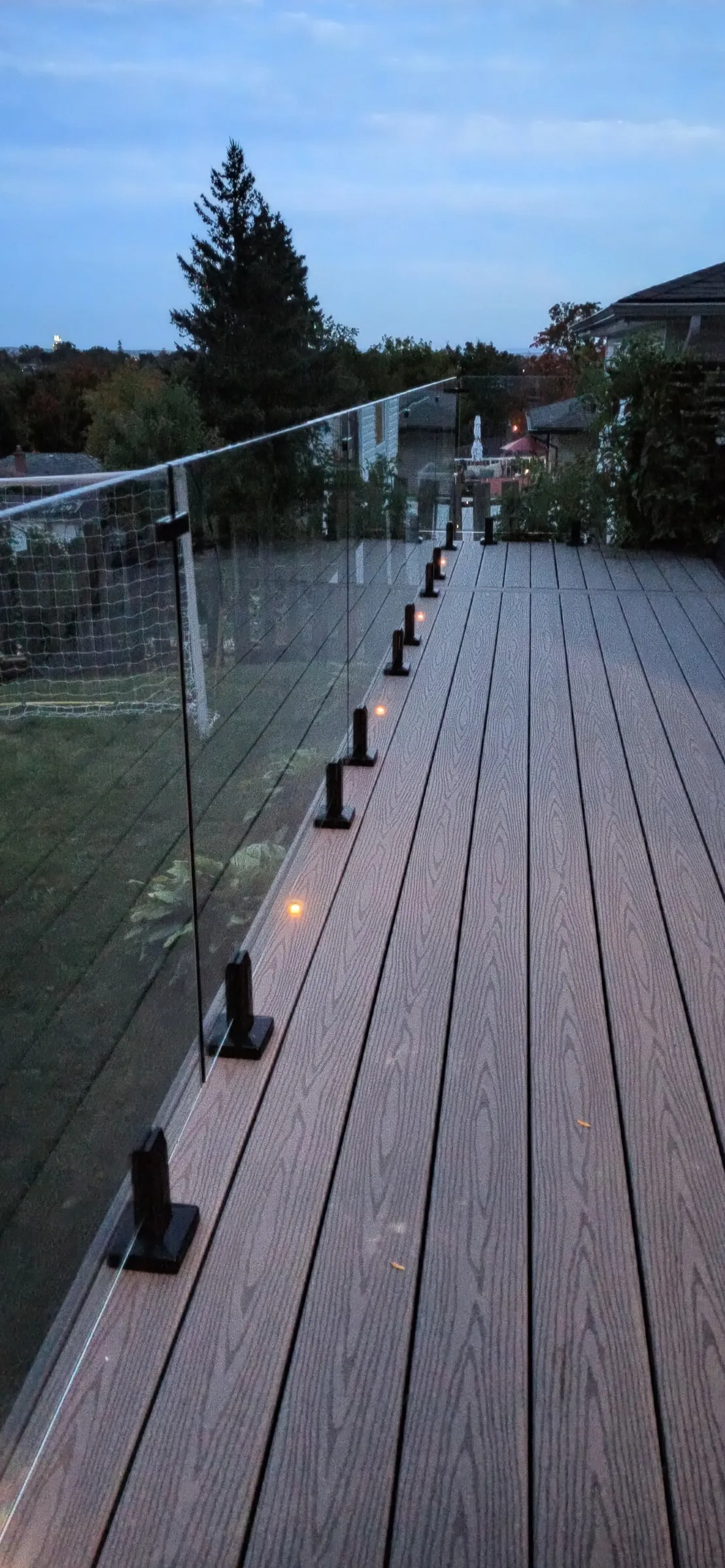
Two things follow that are worth saying out loud. First, 2700 K is at the warm end of the scale. The second is DarkSky's own warning against the usual justification for over-lighting — “brighter does not equal safer.” These are recommendations from a standards body and an advocacy organisation rather than regulation. Nothing obliges you to follow them. They provide useful criteria for reducing glare and spill into neighbouring properties.
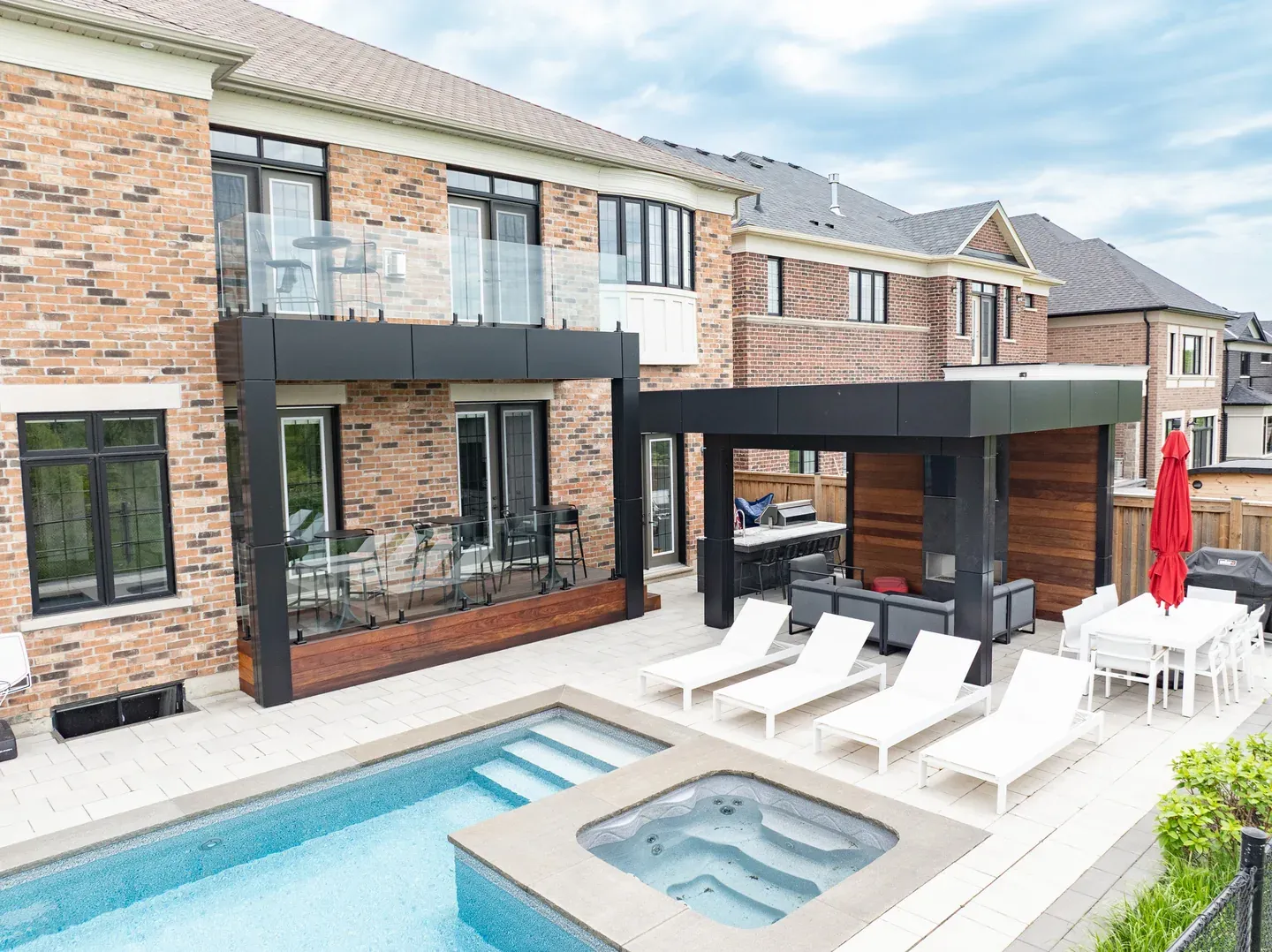
Pools, hot tubs and equipment clearances
Ontario’s Electrical Safety Code has requirements specifically for pools, tubs and spas. ESA’s bulletin 68-7-16, issued May 2025, addresses the lighting question directly:
Q: Does the OESC permit the installation of extra low voltage landscape lighting systems within 3 m of the edge of a swimming pool, spa or hot tub?
A: Yes, provided that the power supply is GFCI protected, as required by Rule 68-068, and does not bear the marking “DO NOT MOUNT POWER SUPPLY OR LUMINAIRES WITHIN 3 m OF A SWIMMING POOL OR SPA.”
That is unusually actionable for a code answer, because the deciding fact is printed on the equipment. The marking comes from CSA C22.2 No. 250.7, the standard for extra-low-voltage landscape lighting systems, and a homeowner can read the label on the transformer they are about to buy. Three more lines from the same bulletin matter on a pool deck:
GFCI within 3 m
Protect all electrical equipment within 3 m of the pool's inside walls, unless a permanent barrier separates it.
ESA Bulletin 68-7-16Rule 68-068. ESA: the barrier needs no openings and must stop anyone touching equipment and water at once.
Receptacles at 1.5 m
Keep receptacles at least 1.5 m from the pool, measured with a string like a cord.
ESA Bulletin 68-7-16Rule 68-064.
Above-ground counts
Apply Section 68 to above-ground pools too, not only in-ground ones.
Meet both the Code and the product instructions. Trex warns against installation close to pools or hot tubs. TimberTech’s linked guide prints conflicting imperial and metric clearances; obtain written clarification before locating its fixtures. ESA’s conditional allowance within 3 m does not override an equipment label or manufacturer restriction. Show the pool or hot tub on the installer’s plan before choosing a system.
What to hand your electrician
A lighting plan that survives contact with a build is short. These are the things a Licensed Electrical Contractor and a deck builder both need, and every one of them is easier to answer before the frame is closed in.
Stairs and treads
Where the stairs land and how many treads — that fixes the riser-light count.
Guard posts
How many — that sets the post cap count, and so the transformer.
Access underneath
Whether you can get under the deck — it decides in-deck fixtures.
The outdoor receptacle
Where it is, and whether it is a Class A GFCI with an “Extra Duty” cover.
WhyIf not, that is 120 V work for the electrician.
Pool or hot tub
Whether one is within 3 m of anything — Section 68 changes the answer.
Anything overhead
Pergola, cabana or soffit lights — a branch circuit best run before the ceiling is closed.
Who files with ESA
Write down who files the notification, and when.
WhyThe item that gets assumed and then does not happen.
Start with Composite Deck Shop’s deck lighting collection, which includes in-lite fixtures and system components. The Trex, TimberTech and Kichler figures above illustrate their own systems; they are not sizing instructions for an in-lite purchase. Match the transformer, cable, connectors and fixtures using the chosen system’s current instructions, and confirm availability with CDS.
Common questions
Can I use any transformer with any fixtures?
Not inside a branded system, and the warranties say so. Trex: “USE TREX TRANSFORMER ONLY. Use of any other transformer voids warranty,” and separately, “Trex lighting operates on DC power. NEVER mix AC and DC fixtures on the same circuit. Doing so will result in extremely premature fixture failure and is not covered by the Trex limited warranty.” TimberTech states that its lighting system “is designed for use with only TimberTech Railing products.” Mixing brands on one run is the cheapest-looking decision on the whole job and the one most likely to cost you a warranty.
Does the Building Code require lights on a deck or its stairs?
Residential entrances have lighting requirements under the Ontario Building Code. That does not establish a universal spacing rule for decorative deck lights. Ask the building department or your designer what is required for your entrance, stairs and any exit route; then plan lighting that makes changes in level easy to see without glare.
Useful sources
Code bulletins, manufacturer instructions and warranty terms are all revised on their own schedules, and the only authority on your project is the edition in force where you live. Open the documents below and confirm before wire goes in.
- Electrical Safety Authority — Bulletin 68-7-16, Swimming pool, hot tub, and spa installations (PDF, issued May 2025): the extra-low-voltage lighting answer within 3 m of a pool, the CSA C22.2 No. 250.7 power supply marking, Rule 68-068 on ground-fault protection and barriers, Rule 68-064's 1.5 m receptacle distance, and Rules 26-704 and 26-708 on outdoor GFCI and “Extra Duty” covers.
- Electrical Safety Authority — Make Your Outdoors Even Greater: Class A GFCI on every backyard 120-volt 15- and 20-amp receptacle, the “Extra Duty” cover plate, the isolating transformer on a low-voltage system, the 60–90 cm and 45–60 cm trench depths, and Ontario One Call before digging.
- Electrical Safety Authority — Do-It-Yourself (DIY) Electrical Work and Notifications and Inspections: “almost all electrical work” reportable, the homeowner-only DIY rule, typical residential notification fees, the Certificate of Acceptance, and the statement that a building permit is not an electrical notification.
- Ontario Building Code — Article 9.34.2.1, Lighting of Entrances: the exterior lighting outlet required at every entrance to a residential building, check the applicable Code and project requirements for entrances, stairs and exit routes.
- Trex — Trex DeckLighting Installation Instructions (PDF): wiring and splitters before decking and railing, the prohibition on wires between joists and deck boards, the transformer capacity table, “use Trex transformer only,” the DC-only warning, the required GFCI outlet, the pools and hot tubs warning, the riser and recessed fixture dimensions, the staple and conduit rules, and the timer and dimmer placement. Hosted by a distributor.
- TimberTech by AZEK — Lighting installation guide (PDF, doc. 10.24): “do not begin deck construction until you have read the lighting instructions,” the 60 W run and 90 W transformer maxima, the fixture wattage table, parallel wiring, the 16/2 AWG main cable and burial limits, the wire-nut instruction, the metal rail post cap detail, and the 10 ft pool separation.
- Kichler — Choosing the Right Transformer for Your Landscape Lighting Job: total VA against transformer wattage, the voltage drop formula, the greater-than-10 V end-fixture rule, multi-tap voltages, and the 12-gauge starting point.
- DarkSky International and the Illuminating Engineering Society — Five Principles for Responsible Outdoor Lighting (June 2020, updated June 2024), and DarkSky's Responsible home outdoor lighting: the five principles in full, the 3000 K or lower recommendation, the 20–50% uplight estimate, and “brighter does not equal safer.”
- Composite Deck Shop — deck lighting: the current Ontario range. The live collection is the authority on availability and price.
This guide is practical public information, not electrical advice and not a substitute for a Licensed Electrical Contractor. Electrical work is regulated in Ontario: the Ontario Electrical Safety Code, the Electrical Safety Authority, your municipality and the current instructions for the exact system you buy govern your deck. If any of this is unclear for your project, ESA's customer service line is 1-877-ESA-SAFE.